
The Alarm Settings screen provides a list of all user-defined alarms.
If Preferred Tags have been specified in the Preferences tab of the current user profile, the list will display a "Tags applied" indicator and only alarms for sites assigned those tags will be included in the list. See Preferences for more information on tags.
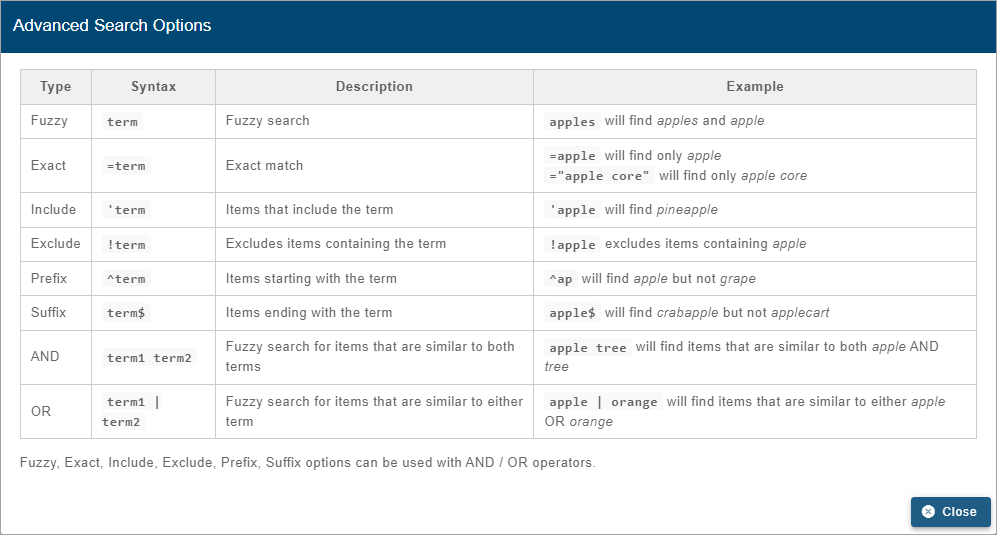
The list can be filtered by entering textual filter criteria in the Search field. The list will automatically be filtered to display only alarms containing the specified text. Advanced Search characters can also be specified with the text to perform different types of searches, some more specific, some more general. Clicking the Advanced Search Options link below the Search field will display a chart of the possible search types and how to use them. The AND/OR operators can also be used in combination with the other Advanced Search options if needed.
A drop-down list beside the Search field can be used to select which property will be searched for the matching text.

When an option has been selected from the list, only alarm settings with text in the selected property (tenant, tag, etc.) will be displayed. Also, when a property is selected from the drop-down list, clicking in the Search field will display a drop-down list of possible values based on the selected property, allowing a value to be selected instead of entering it manually. The Clear Filter button  can be used to remove the filter from the list.
The Show/Hide Inactive control  can also be used to show or hide alarm settings. When enabled, alarms that have been set as Inactive are included in the list, but with a transparent appearance. When disabled, the list only displays active alarms.
The following information is shown for each alarm:
• the name given to alarm
• the Start and End condition of the alarm
• the site being monitored for the alarm
• a Subscribed toggle indicating whether or not the current user is subscribed to notifications for the alarm. Users will only receive notifications from alarms to which they are subscribed.
• the state of the alarm, which can be toggled on to set an alarm as Active or toggled off to set an alarm as Inactive. When an alarm is set to Inactive, it will no longer be triggered or generate notifications. This is useful when alarm settings are no longer relevant, but the alarm cannot be deleted because it has already been triggered.
Additional controls are provided for users with the Analyst, Site Manger or Editor roles, or for the creator of an alarm:
• Edit  : This button is used to open the Configure Alarm page and edit the alarm settings. Alarms can only be edited if they have not been triggered; once an alarm has been triggered, the settings cannot be changed. If the alarm has been triggered, this button will not be available.
• Delete  : This button is used to delete an alarm from the system. Alarms can only be deleted if they have not been triggered. If the alarm has been triggered, this button will not be available.
This page also provides the New Alarm Settings  button, which is used to launch the Configure Alarm page where users can create new alarms. See Configure New Alarm for information on this page.
Related topics:
• Alarms